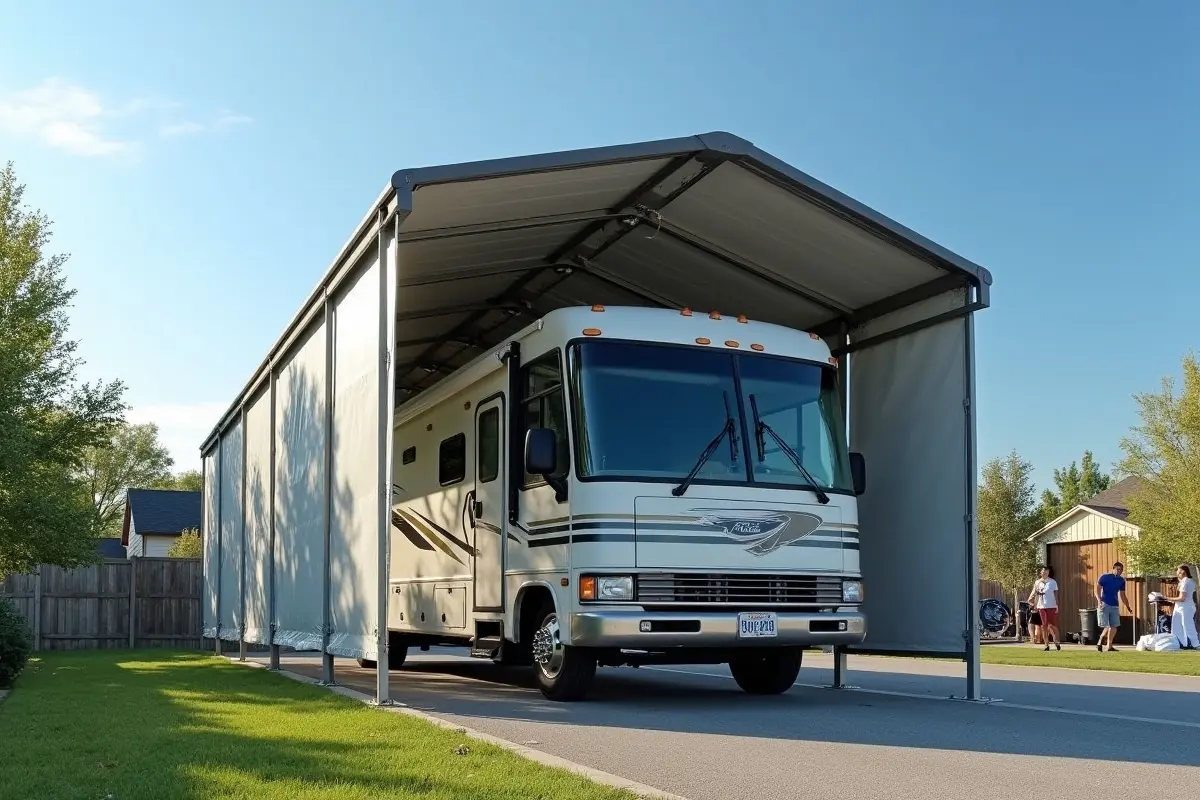
For decades, RV owners relied on heavy fabric RV carports and covers, tarps, or canvas-style shelters to protect their rigs from the elements. These covers offered a low-cost, seemingly easy solution: wrap the RV in a large fabric shell, strap it down, and hope for the best.
Over time, however, many RV owners have realized that these fabric solutions come with hidden costs in terms of convenience, protection, and long-term value. As a result, more RV owners are abandoning fabric covers in favor of permanent metal shelters, such as carports or metal RV garages.
Durability and Weather Protection
Fabric covers, even premium ones, have significant weaknesses. They can tear, sag, or fail under strong winds, heavy rain, hail, or snow. The fabric can rub against the RV’s surface, potentially scratching paint or damaging decals. Moisture trapped underneath can cause mildew, mold, or corrosion over time.
Metal shelters, on the other hand, provide a rigid, weather-resistant shell that withstands wind, rain, snow, and hail. Metal is rust-resistant, fire-resistant, pest-resistant, and does not warp or tear. Because the structure does not touch the RV, there is no risk of wind or friction-induced scratches.
Longevity and Maintenance
The biggest argument for metal shelters is longevity. Fabric covers generally last only a few years under normal weather conditions, often needing replacement every 3–5 years.
Metal shelters can last decades, often 20 to 50 years or more, with minimal maintenance. They do not rot, deform, or degrade like fabric or wood, and only require occasional cleaning or inspection. Many RV owners view a metal shelter not just as a cover, but as a long-term investment and an asset that adds value to their property.
Ease of Use and Accessibility
A major inconvenience of fabric covers is the need to install and remove them, often seasonally. Pulling a heavy tarp over a large RV can be labor-intensive and sometimes requires more than one person. Removing the cover to use the RV adds time and effort.
Metal shelters eliminate that problem. Once installed, you drive the RV in and out, no heavy lifting, straps, or ladders required. This convenience becomes especially important for RV owners who use their vehicles frequently.
Versatility and Added Value
A fabric cover serves only one purpose: covering the RV. A metal shelter, however, can double as storage for other vehicles, tools, or outdoor gear, or serve as a workshop or covered outdoor space. With customization options such as side panels, extended rooflines, or extra storage space, metal shelters are far more versatile and can even increase overall property value.
Long-Term Cost Comparison: Fabric Covers vs. Metal Shelters
One of the most significant objections to metal shelters is the upfront cost. Fabric covers are cheap, typically ranging from $300–$1,500 depending on size and quality.
Metal shelters cost more initially, typically $3,000–$8,000 or more, depending on size, features, and installation.
However, when you spread the cost over the lifespan of the shelter, metal becomes more cost-effective:
- A fabric cover at $800 lasting 3–5 years may need to be replaced 4–6 times over 15–20 years, costing $3,200–$4,800, plus the hassle of installing and removing it each time.
- A metal shelter at $6,000 might last 20–50 years, reducing the annual cost to roughly $120–$300, depending on lifespan and maintenance.
Height and Width Specs for Metal RV Shelters
Before buying a metal shelter, it’s crucial to choose the right size. RVs come in various sizes, and proper clearance is necessary for roof-mounted equipment, slide-outs, and mirrors.
Typical RV Dimensions
- Class A Motorhomes: Up to 45 feet long and around 13–14 feet high.
- Class B Camper Vans: Usually under 23 feet long and 9–10 feet high.
- Class C Motorhomes: Typically 21–33 feet long and 10–12 feet high.
- Fifth-Wheel Trailers: Up to 45 feet long and 13–14 feet high, depending on the model.
Recommended Shelter Dimensions
Because RVs include roof AC units, vents, and slide-outs, the shelter should exceed the RV’s dimensions:
- Height: At least 14.5–15 feet to allow clearance for roof equipment and easy movement.
- Width: Add 2–3 feet on either side of the RV to accommodate mirrors and slide-outs.
- Length: Add 2–3 feet at the front and rear for hitch clearance and maneuvering.
Additional Benefits of Metal Shelters
Besides durability and proper sizing, metal shelters offer several other advantages:
- Property Value Increase: A well-built permanent RV shelter can improve property appeal and resale value.
- Multi-Use Utility: When not storing the RV, the shelter can protect other vehicles, boats, or outdoor equipment, or serve as a workshop.
- Better Protection for the RV Investment: Shields the RV from UV rays, rain, snow, hail, and debris, reducing wear on the paint, tires, and roof materials.
- Convenience: Eliminates the hassle of installing and removing fabric covers each season.
When Fabric Covers Might Still Make Sense
Fabric covers are not entirely useless. For owners who rarely use their RV, move frequently, or have limited space, a fabric cover may still be a short-term solution. They are low-cost, portable, and quick to install.
However, owners must accept the need for frequent replacement, vigilance against moisture and mold, and potential wind or weather damage. Over time, the inconvenience and recurring costs make fabric covers a less appealing long-term solution.
Conclusion
For many RV owners, especially those treating their RV as a long-term investment, switching from $800 fabric covers to a one-time investment in a permanent metal shelter is a wise choice.
While the upfront cost is higher, over 10–20 years, metal shelters are more cost-effective, offer superior protection, and provide convenience and versatility that fabric covers cannot match. With proper planning for height and width, a metal shelter can extend the life of the RV, reduce maintenance costs, and make RV ownership far less stressful.
For most RV owners, the era of fabric covers is ending, and metal shelters are becoming the standard for long-term protection.